Turn your grades fromB to Awith WriteScholar
The all-in-one AI study system to write better essays, study smarter, and get higher grades.
About 30 seconds to get started. No payment today.
Essay
Flashcards
Quiz
Fun Study Games
Trusted by students at top universities worldwide

See how WriteScholar grades a real essay
Switch samples, hover highlights, and check the rubric. Same view you get in the app.
Professor-style review · sample draft (not your work)
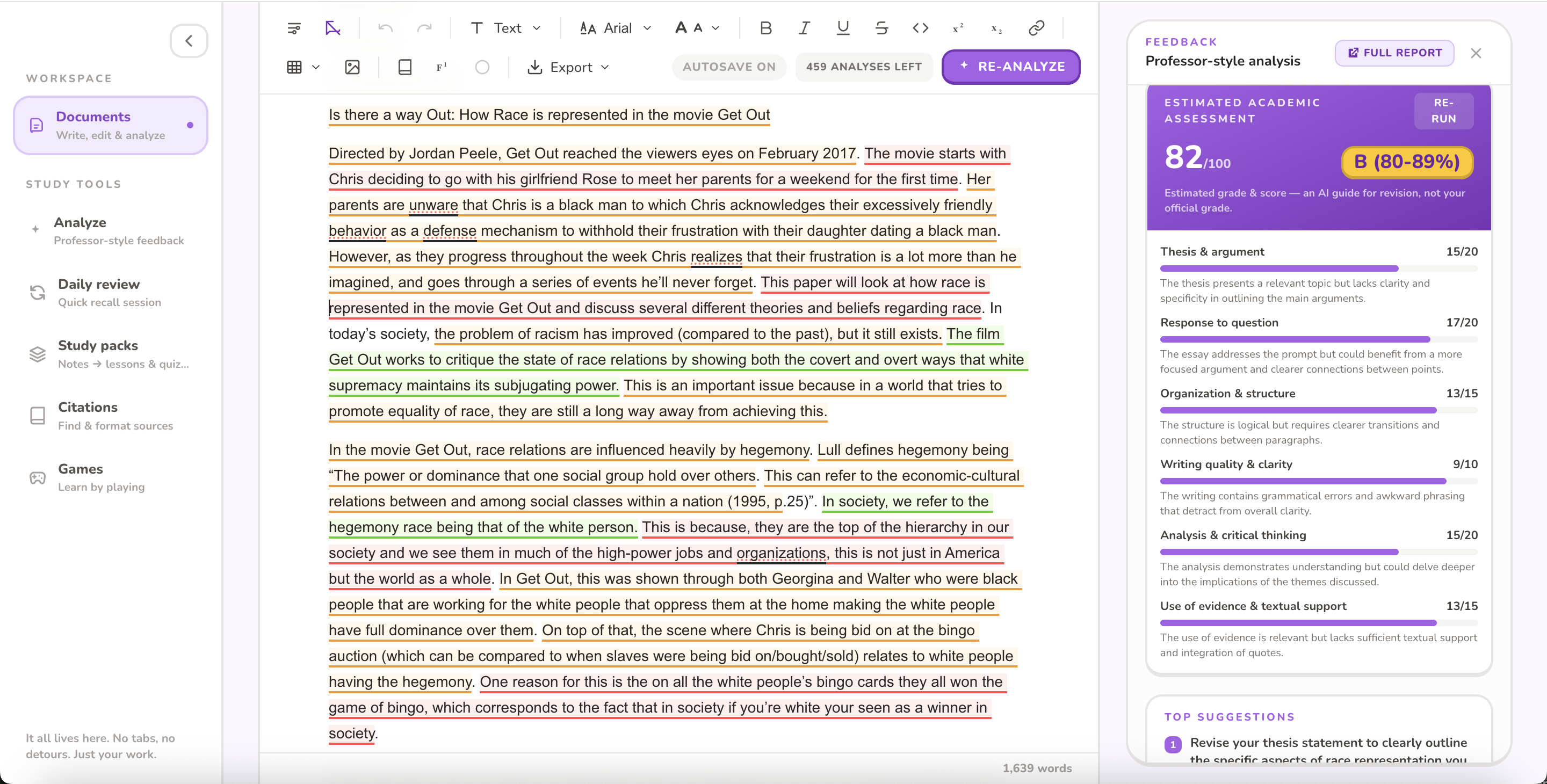
Is there a way Out: How Race is represented in the movie Get Out
General Academic Assessment
The thesis presents a clear argument but lacks depth and specificity in some areas.
The essay addresses the prompt effectively but could improve in clarity and focus.
The structure is somewhat disorganized, affecting the flow of arguments.
Numerous grammatical errors and awkward phrasing hinder clarity.
The analysis is insightful but could benefit from deeper exploration of key concepts.
Evidence is used but lacks consistency in citation format and depth of analysis.
Click highlights to explore feedback
Is there a way Out: How Race is represented in the movie Get Out
Directed by Jordan Peele, Get Out reached the viewers eyes on February 2017. The movie starts with Chris deciding to go with his girlfriend Rose to meet her parents for a weekend for the first time. Her parents are unware that Chris is a black man to which Chris acknowledges their excessively friendly behavior as a defense mechanism to withhold their frustration with their daughter dating a black man. However, as they progress throughout the week Chris realizes that their frustration is a lot more than he imagined, and goes through a series of events he'll never forget. This paper will look at how race is represented in the movie Get Out and discuss several different theories and beliefs regarding race. In today's society, the problem of racism has improved (compared to the past), but it still exists. The film Get Out works to critique the state of race relations by showing both the covert and overt ways that white supremacy maintains its subjugating power. This is an important issue because in a world that tries to promote equality of race, they are still a long way away from achieving this.
In the movie Get Out, race relations are influenced heavily by hegemony. Lull defines hegemony being "The power or dominance that one social group hold over others. This can refer to the economic-cultural relations between and among social classes within a nation (1995, p.25)". In society, we refer to the hegemony race being that of the white person. This is because, they are the top of the hierarchy in our society and we see them in much of the high-power jobs and organizations, this is not just in America but the world as a whole. In Get Out, this was shown through both Georgina and Walter who were black people that are working for the white people that oppress them at the home making the white people have full dominance over them. On top of that, the scene where Chris is being bid on at the bingo auction (which can be compared to when slaves were being bid on/bought/sold) relates to white people having the hegemony. One reason for this is the on all the white people's bingo cards they all won the game of bingo, which corresponds to the fact that in society if you're white your seen as a winner in society.
Race was also shown through the use gender roles. In Multicultural Film: An Anthology, Schrock and Schwalbe discuss masculinity and the difference roles that society put on gender by quoting: "Children are born into a world in which males/boys/men are differentiated from females/girls/women. They must learn and master "identity codes" that symbolizes their particular gender role" (2009, p.151). An example of this from the movie was with both the black servants Walter and Georgina being used by the Armitage family (the white family in the movie) differently due to gender, as Walter the black man had a more "masculine" job of working on the farm and doing the heavy lifting to that of Georgina who was cooking, cleaning and doing what's seen as more "feminine" work. This shows one of the overt ways in which white supremacy maintains its power by having black people work for them being there servants with no opportunity of them ever having the chance to have a job role of any significance.
Even though they might look slightly different from the past, racist traditions of white supremacy are constantly being upheld for the purpose of maintaining power. In Get Out, the Sunken Place is a metaphor for the state of mind of minorities who have been brainwashed by white supremacy. They are being controlled by the hegemonic powers already in place. The scene where Missy Armitage hits the teacup with the silver spoon hypnotizing Chris is an example of this. What makes the teacup symbolic, is that during the slavery days in America, white wives of the slave owners would strike the teacup as a way of activating the slaves and using their hegemonic powers to control the black people. Andre talks about stereotypes in the fact they tend to ignore, or falsify or oversimply the causes of a certain behavior. She goes on to talk about stereotypes and that they suggest the behavior is something that is inevitable and this causes a distorted reality (2016 p.63). Stereotypes are one of the covert ways that the Armitage family In Get Out use as an excuse for why it's acceptable for them to have power over the black race. The Armitage family say that black men are naturally much stronger than the other races so they should be in jobs that utilizes their strength, to which are covertly the jobs that involve the black man doing all the slave work for the white people. White privilege is something that society constantly tries to disregard as they try to maintain the belief that we live in an equal world, however whether we like it or not white privilege is constantly happening in our day to day life and on many occasions, it's subconscious without the individual even knowing of their privilege. McIntosh refers to the while privilege as "an invisible package of unearned assets which I can count on cashing in each day, but about which I was meant to remain oblivious". The silver spoon that Missy Armitage constantly used throughout the movie was meant to be a symbol of white privilege as throughout generations the white race would be born into society with a "silver spoon" just due to the mere fact they are white and maintain its subjugating power over other races.
One form of racism that is often overlooked in the modern society is micro-aggressions. The main reason for this is they are subtle and not overly obvious when done, however they can obviously be very telling about the deeply rooted racist mentalities that oppressors hold. Microaggressions is something that is happening in a lot of conversations throughout our daily activities, with some of the time without us noticing. Sue et al puts microaggressions into three categories which are: microinsult (characterized by communications that convey rudeness to a person's race), microassault (racial derogation through verbal or nonverbal attack that's meant to hurt victim like name calling) and microinvalidation (communications that exclude, negate or nullify the feelings or experiential reality of a person of color (209, p.202-203)). One of the most common type of racial microaggressions heavily used in society is the phrase "I'm not a racist. I have several Black friends." This is people's belief that because they have a friend of that race that automatically makes them immune to racism. A supporting scene of microaggressions was shown in Get Out when Dean Armitage (Rose's father) was generalizing black people in his comments towards Chris by saying "If I could, I would have voted for Obama for a third term". This comment he made was unnecessary and was only used due to the fact Chris is black and deep down trying to hide the fact that he is racist. However, is there a way we can prove what he was saying was used in a racist way? This is one thing Sue et al states are the greatest challenges us as a society and mental health professions face is trying to make the "invisible" "visible". Which may only be possible once our society is honest about race and racism and we openly have discussions about this matter, but with this potentially resulting in the dominant white race losing a slight sense of power why would they engage (p.212).
In conclusion, when people watch the movie Get Out, there is always a different reaction from one person watching it to another, with a person's race being one of the huge factors on how they perceive the movie. The main reason for this is because some people still don't understand race relations, due to the fact they don't experience it, and things you can't experience you have a much harder time noticing it's happening. In today's society, the problem of racism has improved (compared to the past), but we have seen through-out this movie it still exists in many different shapes and forms. The film Get Out works to critique the state of race relations by showing both the covert and overt ways that white supremacy maintains its subjugating power in society. Overall the movie Get Out was a good starting point to talk about the issues of racism in society. I think that in society now, racism is more covert racism to that of the past that was heavily overt, as now racism is heavily frowned upon. However, with these issues still being a huge problem, eliminating racism might be a task that we as society are way far from tackling and may never be able to tackle.
Bibliography:
Andre, Judith. "Stereotypes: Conceptual and Normative Considerations." Multicultural Film: An Anthology. Fall 2016/Spring-Summer 2017. Eds. Kathryn Karrh Cashin and Lauren Martilli. Boston, MA: Pearson, 2016. Book.
Get Out. Dir. Jordan Peele. Perf. Daniel Kaluuya, Allison Williams, and Catherine Keener. Universal Pictures, 2017. DVD.
Lull, James. "Hegemony." Media, Communication, Culture: A Global Approach. New York: Columbia University Press, 1995.
McIntosh, Peggy. "White Privilege: Unpacking the Invisible Knapsack." Peace and Freedom July/August (1989): 10-12.
Schrock, Douglas and Michael Schwalbe. "Men, Masculinity, and Manhood Acts" Multicultural Film: An Anthology. Fall 2016/Spring-Summer 2017. Eds. Kathryn Karrh Cashin and Lauren Martilli. Boston, MA: Pearson, 2016. Book.
Sue, Derald Wing, Christina M. Capodilupo, Gina C. Torino, Jennifer M. Bucceri, Aisha M. B. Holder, Kevin L. Nadal. And Marta Esqulin. "Racial Microaggressions in Everyday Life: Implications for Clinical Practice." American Psychologist 62.4 (2009): 271-86
Not just a grader.A full writing workspace.
Write your essay in a real editor with live, professor-style feedback in the margin. Apply suggested fixes straight into your draft, then export a perfectly formatted Word doc.
Live grade & rubric
An estimated grade band and a full professor-style rubric, updating as you write. No copy-paste loop.
One-click apply
Accept a suggested rewrite and it drops straight into your draft, exactly where it belongs.
Built for real essays
Write the actual paper here. Tables, images, citations and footnotes are built in, not bolted on.
Word in, Word out
Import a .docx and your bold, italics and headings carry over. Export and it comes back perfectly formatted.
No credit card · Free previews on your own work

Unleash the power of your course materials.
Upload your materials once and unlock a suite of tools designed to help you understand faster, retain longer, and stress less.
Write, revise and fix your draft in one workspace.
Distraction-free editor with the rubric, citations and one-click fixes right next to your draft.
Every tool, in detail
Transform your notes into powerful study tools
Plus · Arcade mode
Make revision feel like a game
Every Study Pack also unlocks three arcade games — built from the same notes you just pasted in.

Free previews included · No credit card·No credit card·Cancel anytime
How your notes become a complete study system
Into personalized, AI-powered .

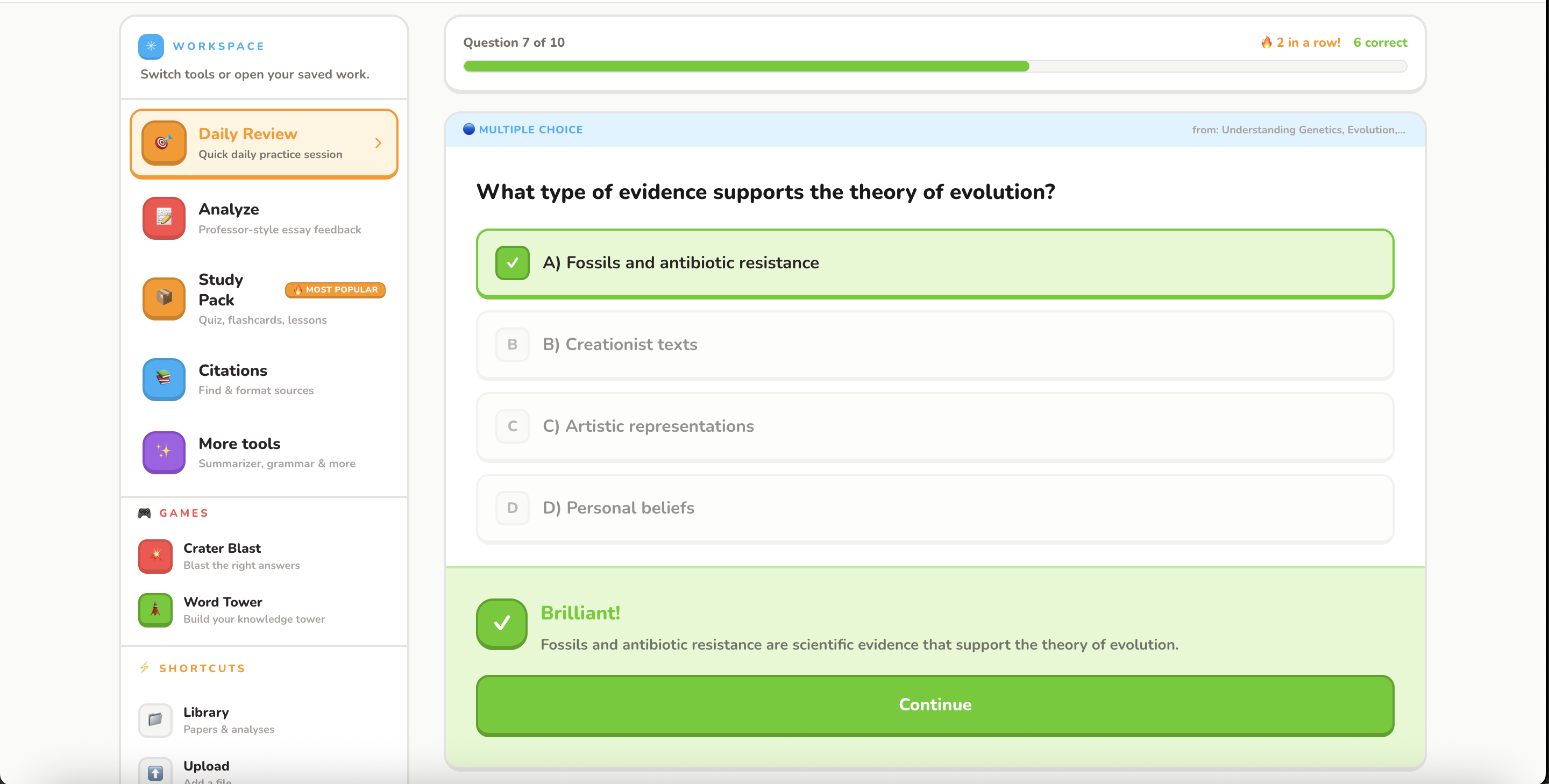
Daily review
Quizzes
Arcade
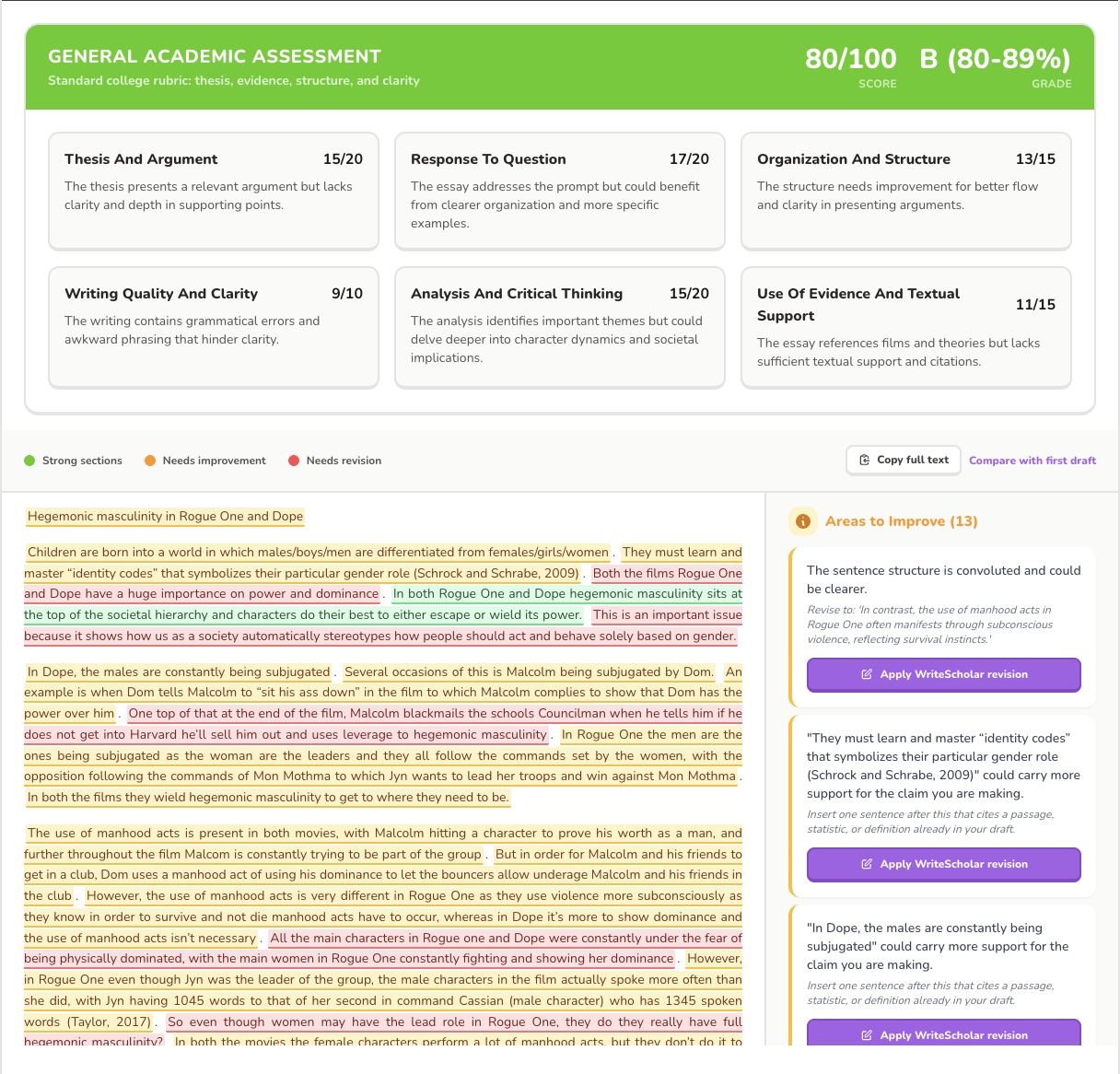
Editor
Essay grade
Flashcards

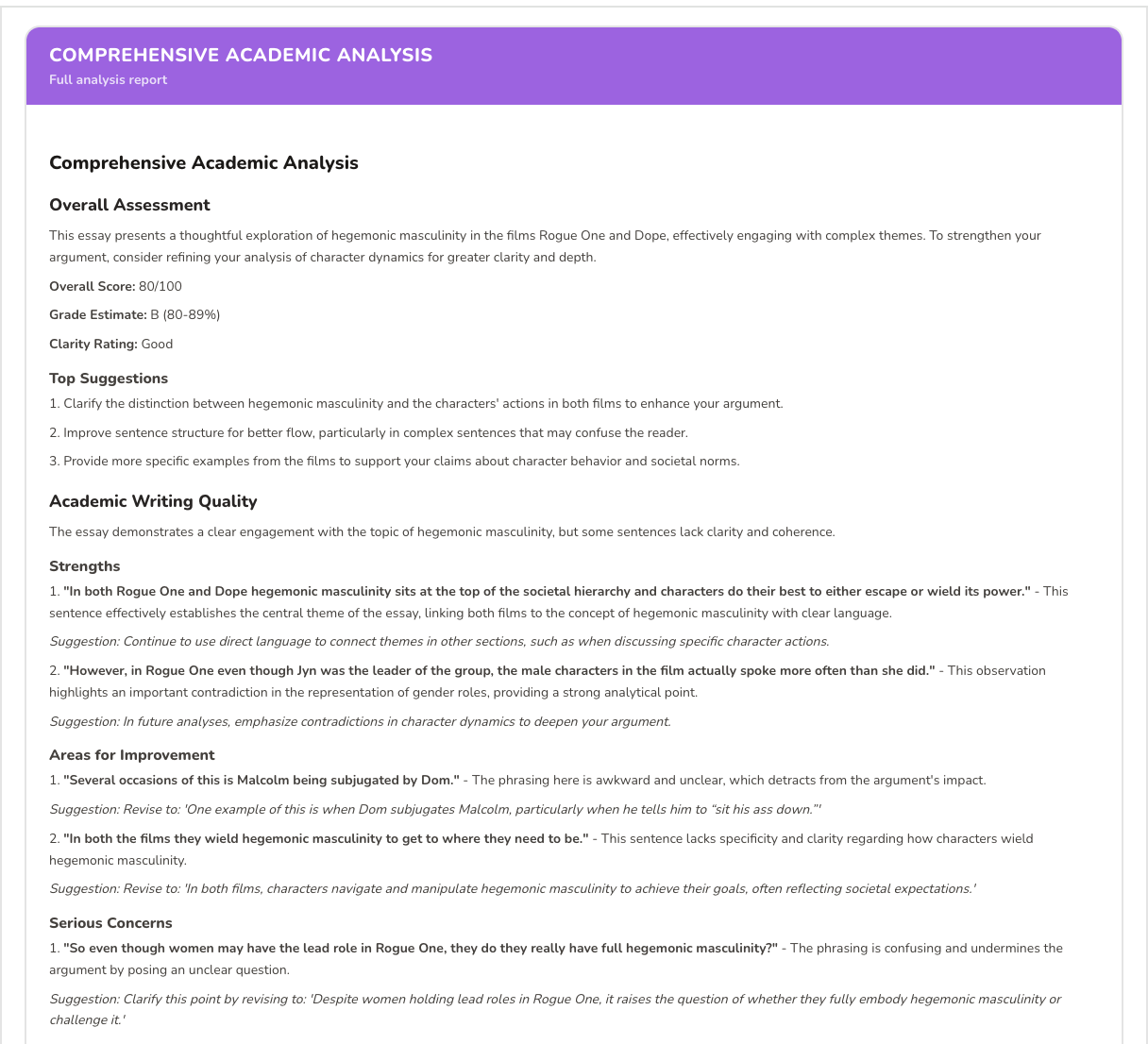

Five things our analyzer never misses.
Every essay you upload gets the same five-point treatment. Hover any annotation for the explanation.
Analyse your first essay free — no credit card · Encrypted in transit · Cancel anytime · Study tools live under


Studying that actually sticks.
Most students give up after week two. WriteScholar's streak + XP system makes studying the easy choice, so you actually show up the day before the test.
Daily Review
10 minutes a day beats 4 hours of cramming. Your personalised drill from saved notes, built around what you keep getting wrong.
3 of 5 questions done
XP & 100 Levels
Every essay reviewed, every quiz aced, every streak day. They all stack into XP and levels you actually want to chase.
Knowledge Keeper III
Daily Streaks
Your streak is your accountability. Miss a day and you'll feel it. That's how casual users become 4.0 students.
14
day streak
80+ Badges
Visible milestones turn "I should study" into "I want my next badge." It works because it's stupid and you can't help it.
5 of 80+ unlocked
Your daily practice session: questions pulled from your own study materials, with instant feedback and XP rewards.
Level up!
Curious Cat II
Confetti, celebrations, and a new title every time you level up.
On the work they actually hand in
Drafted in the editor, graded by the AI. Real student stories about essays written and marked inside WriteScholar.
Matthew H.English 102 final: B+ → A (92/100)
I just write my drafts straight in WriteScholar now and the rubric score moves while I edit. It actually showed me which criteria I kept dropping marks on. Honestly it was harsher than ChatGPT and my TA, but that's the thing that got me from a B+ to an A.
Apr 18, 2026
Rumaysah K.Sophomore year GPA: 2.7 → 3.8
My problem was never effort, it was speed. Office hours and TA availability capped how many drafts I could actually get marked. Now I write the essay in the editor and get it graded the same minute, so I revise right away instead of waiting a week. The accuracy is what sold me. Compared to my real professor scores it's only 2 to 3 points off out of 100, and it tells you the truth instead of inflating your grade the way other AI tools do. I tell everyone in my upper-division humanities classes about it.
Mar 02, 2026
Leon P.Pulled American Lit from C to A- in one semester
I was sitting on a C after midterms and kind of panicking. I'd write a paragraph, get feedback in the margin, and drop the fix straight into my draft. No copy-pasting between tabs. Three practice essays later my close reading actually held up and I finished on a 91, which was an A-.
Dec 11, 2025
Subhaan A.Term paper score: 72 → 89 (Psych 250)
I was putting in the work but I genuinely didn't know where I was going wrong, and the writing center had a two-week wait. WriteScholar told me, line by line, which evidence wasn't pulling its weight and where my analysis stayed shallow. After a couple of term papers in the editor I was consistently hitting 89+, and the free plan was enough to pull my course grade up to an A-.
Feb 21, 2026
Aisha R.Stopped reformatting before every submission
I import my Word doc, write and fix everything inside WriteScholar, then export it back, and the formatting comes out exactly right. I used to lose a full hour reformatting before every submission. Now I don't even open Word until it's done.
May 06, 2026
James O.Sociology essay: 68 → 90
It's basically a writing coach that lives in my document. I draft in the editor and the feedback panel keeps updating as I go, so by the time I finish a section it's already been picked apart and rebuilt. My last essay went from a 68 on the first attempt to a 90. Same effort, way less guessing.
Jan 28, 2026
Tomás G.Phil 305 comparative essay: 76 → 94
I expected another AI that calls every essay 'great'. This one actually pushed back. It flagged my thesis as too broad and called out three logic gaps right there in the draft. My philosophy professor is brutal and this matched his standards. Worth every dollar of Pro.
Apr 30, 2026
Elena V.TA marked her draft 12 points higher (80 → 92)
English isn't my first language, so 'awkward phrasing' feedback never actually told me what to do. Writing in WriteScholar, it points at the exact words to swap and the sentences to tighten while I type. My TA gave my second draft a 92 out of 100 versus the 80 my first one got. She said it 'sounded smoother' and couldn't say why. I knew why.
Mar 19, 2026
Pricing
Simple, transparent pricing
Start free, upgrade when you need more analyses, citations, and study tools.
Free
Try it free — see a real result on your own work
- 1 free essay analysis — grade, issues & top fixes (full report with Pro)
- 1 free study pack — lesson + 4 flashcards (quiz & games with Pro)
- 1 free citation search — 3 sources (full list with Pro)
- 3 documents/mo, 5k-word summarizer, 2MB storage
Pro
Most popular for students
- 99 combined analyses, study packs & citations/mo
- 999,999 words Paper Summarizer; uploads up to 100MB
- Quiz, flashcards, crossword, Crater Blast & Word Tower
- All citation styles, PDF/Word export
- Apply WriteScholar revisions into your draft
Premium
Heavy essays & citations
- Everything in Pro
- 499 combined analyses, study packs & citations/mo—ideal for citation-heavy work
- Summarise unlimited research papers; 1GB library storage
Free to start. Pro and Premium upgrades available with monthly or yearly billing.
Frequently Asked Questions
Essay feedback, citations, and study tools for college and university coursework.

Your next essay could be an A.
50K+
Students worldwide
91%
of frequent active users reported better grades
No payment today · Cancel anytime · Secure checkout via Stripe