
AI essay graders have multiplied since 2022, at least 20 are now competing for college students' attention. Most are mediocre. The problem isn't the AI; it's how grades are calibrated. An A on one platform is a B+ on another. This guide compares the five tools college students actually use, scored on what matters: rubric depth, grade calibration, line-by-line feedback, and price.
Every tool graded the same 1,500-word argumentative essay, already marked by a freshman composition instructor. We scored each on rubric depth, how close its grade landed to the instructor's, whether it annotated specific lines, and what a college student actually pays per month.
Top AI essay graders compared
Tested on the same 1,500-word argumentative essay across all platforms.
| Tool | Rubric depth | Grade calibration | Line annotations | Price |
|---|---|---|---|---|
| ★ Our pickWriteScholar | 5 categories + sub-criteria | Calibrated to college rubrics | Yes, interactive | 3 free credits/mo · $19.99/mo Pro (99 credits, first month $9.99) |
| Grammarly Premium | Style/clarity only | No essay grade | Yes, grammar focus | $30/mo |
| ProWritingAid | Style/structure | No essay grade | Yes, comprehensive | $120/year |
| EssayGrader.ai | Single grade only | Inconsistent | Limited | $15/mo |
| ChatGPT (GPT-4) | Variable | Generous (inflated) | On request | $20/mo |
What the top pick actually looks like
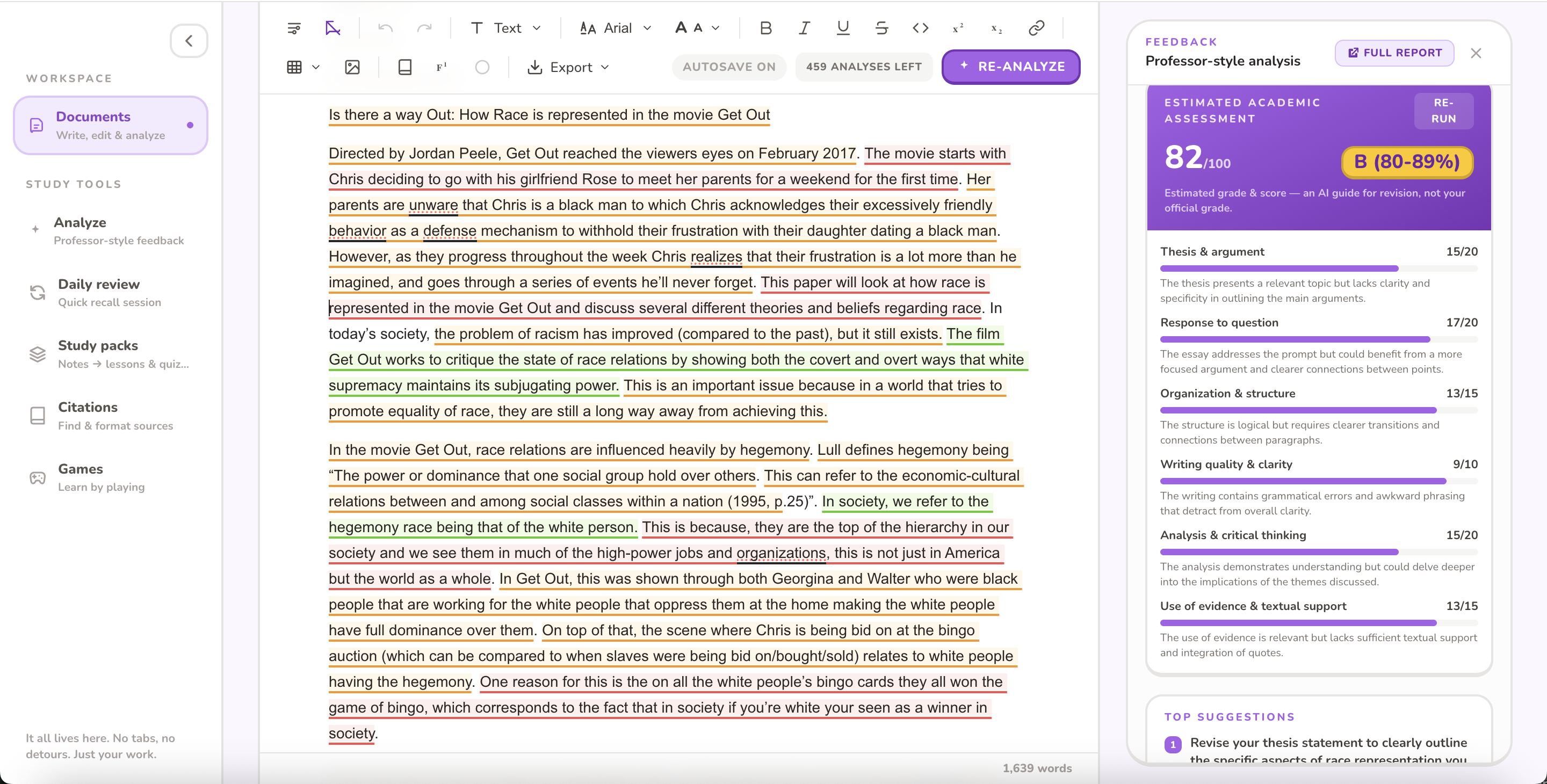
Professor-style review · sample draft (not your work)
Is there a way Out: How Race is represented in the movie Get Out
General Academic Assessment
The thesis presents a clear argument but lacks depth and specificity in some areas.
The essay addresses the prompt effectively but could improve in clarity and focus.
The structure is somewhat disorganized, affecting the flow of arguments.
Numerous grammatical errors and awkward phrasing hinder clarity.
The analysis is insightful but could benefit from deeper exploration of key concepts.
Evidence is used but lacks consistency in citation format and depth of analysis.
Click highlights to explore feedback
Is there a way Out: How Race is represented in the movie Get Out
Directed by Jordan Peele, Get Out reached the viewers eyes on February 2017. The movie starts with Chris deciding to go with his girlfriend Rose to meet her parents for a weekend for the first time. Her parents are unware that Chris is a black man to which Chris acknowledges their excessively friendly behavior as a defense mechanism to withhold their frustration with their daughter dating a black man. However, as they progress throughout the week Chris realizes that their frustration is a lot more than he imagined, and goes through a series of events he'll never forget. This paper will look at how race is represented in the movie Get Out and discuss several different theories and beliefs regarding race. In today's society, the problem of racism has improved (compared to the past), but it still exists. The film Get Out works to critique the state of race relations by showing both the covert and overt ways that white supremacy maintains its subjugating power. This is an important issue because in a world that tries to promote equality of race, they are still a long way away from achieving this.
In the movie Get Out, race relations are influenced heavily by hegemony. Lull defines hegemony being "The power or dominance that one social group hold over others. This can refer to the economic-cultural relations between and among social classes within a nation (1995, p.25)". In society, we refer to the hegemony race being that of the white person. This is because, they are the top of the hierarchy in our society and we see them in much of the high-power jobs and organizations, this is not just in America but the world as a whole. In Get Out, this was shown through both Georgina and Walter who were black people that are working for the white people that oppress them at the home making the white people have full dominance over them. On top of that, the scene where Chris is being bid on at the bingo auction (which can be compared to when slaves were being bid on/bought/sold) relates to white people having the hegemony. One reason for this is the on all the white people's bingo cards they all won the game of bingo, which corresponds to the fact that in society if you're white your seen as a winner in society.
Race was also shown through the use gender roles. In Multicultural Film: An Anthology, Schrock and Schwalbe discuss masculinity and the difference roles that society put on gender by quoting: "Children are born into a world in which males/boys/men are differentiated from females/girls/women. They must learn and master "identity codes" that symbolizes their particular gender role" (2009, p.151). An example of this from the movie was with both the black servants Walter and Georgina being used by the Armitage family (the white family in the movie) differently due to gender, as Walter the black man had a more "masculine" job of working on the farm and doing the heavy lifting to that of Georgina who was cooking, cleaning and doing what's seen as more "feminine" work. This shows one of the overt ways in which white supremacy maintains its power by having black people work for them being there servants with no opportunity of them ever having the chance to have a job role of any significance.
Even though they might look slightly different from the past, racist traditions of white supremacy are constantly being upheld for the purpose of maintaining power. In Get Out, the Sunken Place is a metaphor for the state of mind of minorities who have been brainwashed by white supremacy. They are being controlled by the hegemonic powers already in place. The scene where Missy Armitage hits the teacup with the silver spoon hypnotizing Chris is an example of this. What makes the teacup symbolic, is that during the slavery days in America, white wives of the slave owners would strike the teacup as a way of activating the slaves and using their hegemonic powers to control the black people. Andre talks about stereotypes in the fact they tend to ignore, or falsify or oversimply the causes of a certain behavior. She goes on to talk about stereotypes and that they suggest the behavior is something that is inevitable and this causes a distorted reality (2016 p.63). Stereotypes are one of the covert ways that the Armitage family In Get Out use as an excuse for why it's acceptable for them to have power over the black race. The Armitage family say that black men are naturally much stronger than the other races so they should be in jobs that utilizes their strength, to which are covertly the jobs that involve the black man doing all the slave work for the white people. White privilege is something that society constantly tries to disregard as they try to maintain the belief that we live in an equal world, however whether we like it or not white privilege is constantly happening in our day to day life and on many occasions, it's subconscious without the individual even knowing of their privilege. McIntosh refers to the while privilege as "an invisible package of unearned assets which I can count on cashing in each day, but about which I was meant to remain oblivious". The silver spoon that Missy Armitage constantly used throughout the movie was meant to be a symbol of white privilege as throughout generations the white race would be born into society with a "silver spoon" just due to the mere fact they are white and maintain its subjugating power over other races.
One form of racism that is often overlooked in the modern society is micro-aggressions. The main reason for this is they are subtle and not overly obvious when done, however they can obviously be very telling about the deeply rooted racist mentalities that oppressors hold. Microaggressions is something that is happening in a lot of conversations throughout our daily activities, with some of the time without us noticing. Sue et al puts microaggressions into three categories which are: microinsult (characterized by communications that convey rudeness to a person's race), microassault (racial derogation through verbal or nonverbal attack that's meant to hurt victim like name calling) and microinvalidation (communications that exclude, negate or nullify the feelings or experiential reality of a person of color (209, p.202-203)). One of the most common type of racial microaggressions heavily used in society is the phrase "I'm not a racist. I have several Black friends." This is people's belief that because they have a friend of that race that automatically makes them immune to racism. A supporting scene of microaggressions was shown in Get Out when Dean Armitage (Rose's father) was generalizing black people in his comments towards Chris by saying "If I could, I would have voted for Obama for a third term". This comment he made was unnecessary and was only used due to the fact Chris is black and deep down trying to hide the fact that he is racist. However, is there a way we can prove what he was saying was used in a racist way? This is one thing Sue et al states are the greatest challenges us as a society and mental health professions face is trying to make the "invisible" "visible". Which may only be possible once our society is honest about race and racism and we openly have discussions about this matter, but with this potentially resulting in the dominant white race losing a slight sense of power why would they engage (p.212).
In conclusion, when people watch the movie Get Out, there is always a different reaction from one person watching it to another, with a person's race being one of the huge factors on how they perceive the movie. The main reason for this is because some people still don't understand race relations, due to the fact they don't experience it, and things you can't experience you have a much harder time noticing it's happening. In today's society, the problem of racism has improved (compared to the past), but we have seen through-out this movie it still exists in many different shapes and forms. The film Get Out works to critique the state of race relations by showing both the covert and overt ways that white supremacy maintains its subjugating power in society. Overall the movie Get Out was a good starting point to talk about the issues of racism in society. I think that in society now, racism is more covert racism to that of the past that was heavily overt, as now racism is heavily frowned upon. However, with these issues still being a huge problem, eliminating racism might be a task that we as society are way far from tackling and may never be able to tackle.
Bibliography:
Andre, Judith. "Stereotypes: Conceptual and Normative Considerations." Multicultural Film: An Anthology. Fall 2016/Spring-Summer 2017. Eds. Kathryn Karrh Cashin and Lauren Martilli. Boston, MA: Pearson, 2016. Book.
Get Out. Dir. Jordan Peele. Perf. Daniel Kaluuya, Allison Williams, and Catherine Keener. Universal Pictures, 2017. DVD.
Lull, James. "Hegemony." Media, Communication, Culture: A Global Approach. New York: Columbia University Press, 1995.
McIntosh, Peggy. "White Privilege: Unpacking the Invisible Knapsack." Peace and Freedom July/August (1989): 10-12.
Schrock, Douglas and Michael Schwalbe. "Men, Masculinity, and Manhood Acts" Multicultural Film: An Anthology. Fall 2016/Spring-Summer 2017. Eds. Kathryn Karrh Cashin and Lauren Martilli. Boston, MA: Pearson, 2016. Book.
Sue, Derald Wing, Christina M. Capodilupo, Gina C. Torino, Jennifer M. Bucceri, Aisha M. B. Holder, Kevin L. Nadal. And Marta Esqulin. "Racial Microaggressions in Everyday Life: Implications for Clinical Practice." American Psychologist 62.4 (2009): 271-86
Switch samples, hover the highlights, and check the rubric. Same view you get in the app.
What "best" actually means for college essay grading
Rubric depth
Best graders break feedback into 5+ categories (thesis, structure, evidence, style, mechanics), same as how professors actually grade. Single-grade tools miss the diagnostic value.
Calibration
A grader that gives every essay a B+ is useless. Best graders are calibrated to give roughly the distribution real professors give: 20% A, 40% B, 30% C, 10% below. WriteScholar tested with 200 graded essays from across freshman composition.
Line-by-line annotations
A holistic grade is fine; line annotations are where actual learning happens. "This sentence is unclear" is more useful than "your style is good".
Polished revision
The strongest graders also output a revised version of your essay so you can compare what could be different.
Price
College students aren't paying $50/month for grading. WriteScholar Pro is $19.99/mo for 99 credits — and $1 gets you 7 days to test it on your own essays first.
When NOT to use AI essay grading
High-stakes academic submissions
For graded papers and theses, AI feedback is for revision, never submit text generated by AI. Universities use AI detectors; some are accurate, some aren't.
Personal writing
AI graders are calibrated to academic conventions. They'll grade your memoir or short story by rubric, not creative merit.
When you haven't drafted yet
Grading a half-formed essay produces low-quality feedback. Get to a complete draft, then run it through a grader.
Frequently asked questions

Are AI essay graders accurate?
Will my professor know I used an AI grader?
What's the catch with the free grades?
Can AI graders grade as well as professors?
Which is best for med school applications?
Is WriteScholar genuinely better, or are you biased?

Ready to try it free?
Three study packs or essay grades a month are free; Pro is $19.99/mo. Cancel anytime. WriteScholar takes your notes and turns them into the study tools you actually use.
Grade my essay