AI essay grader & editor
Essay grader: see your grade
before you submit
Paste or import your essay and get an estimated grade, a professor-style rubric and line-by-line fixes in about 60 seconds. Rate your essay now and raise the grade before anyone marks it.
$1 for 7 days · cancel anytime. The grade is an estimate to sharpen your draft, not a guarantee.
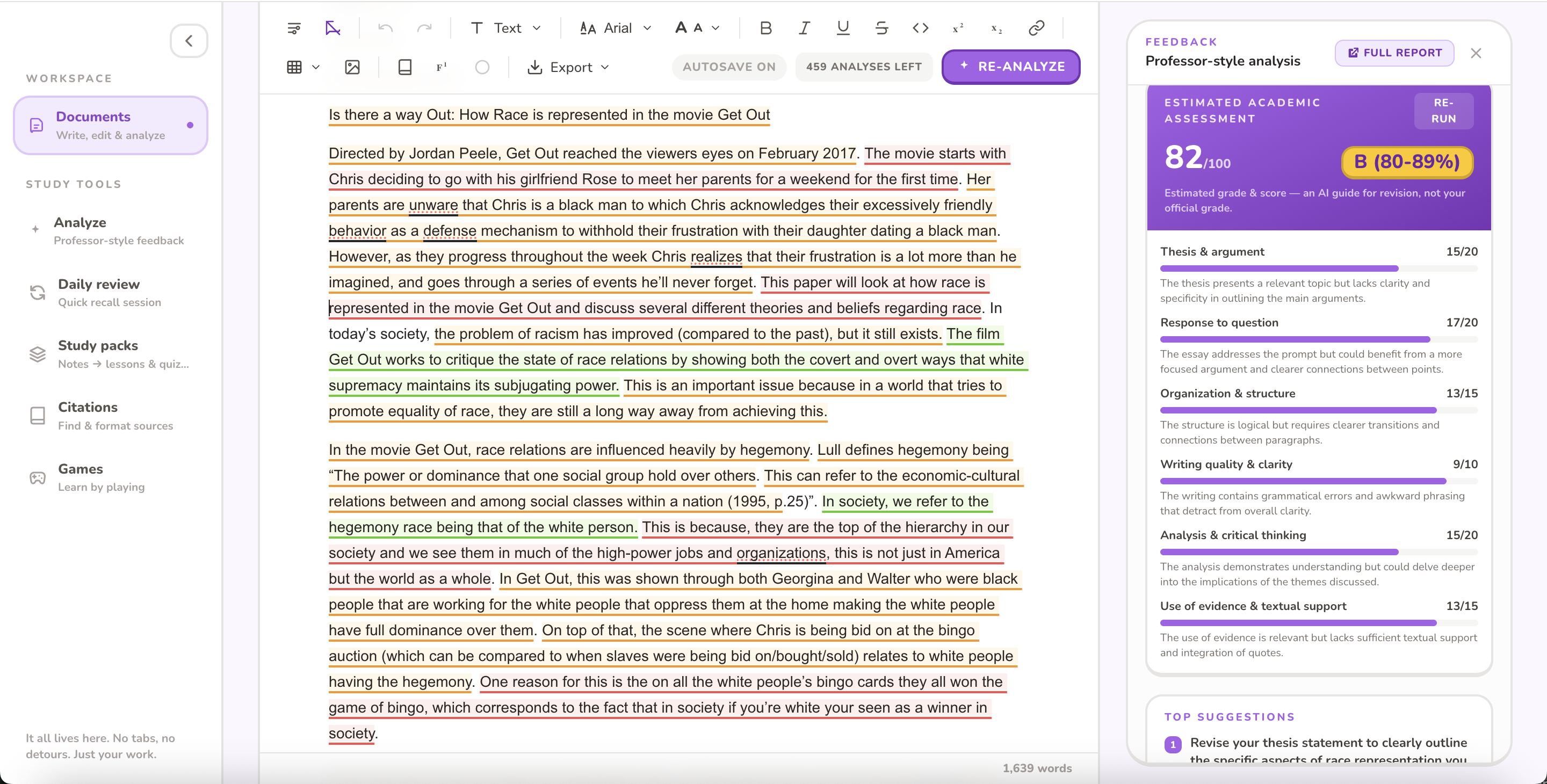
Watch it grade a real essay
Paste a draft, get an estimated grade and a full rubric in about 60 seconds, then apply the fixes straight into the editor.
How the AI essay grader works
Write or import your essay
Draft in a real editor, or import a .docx, PDF or TXT. Bold, italics, headings, tables, citations and footnotes carry over, nothing to reformat.
Get an estimated grade and a full rubric
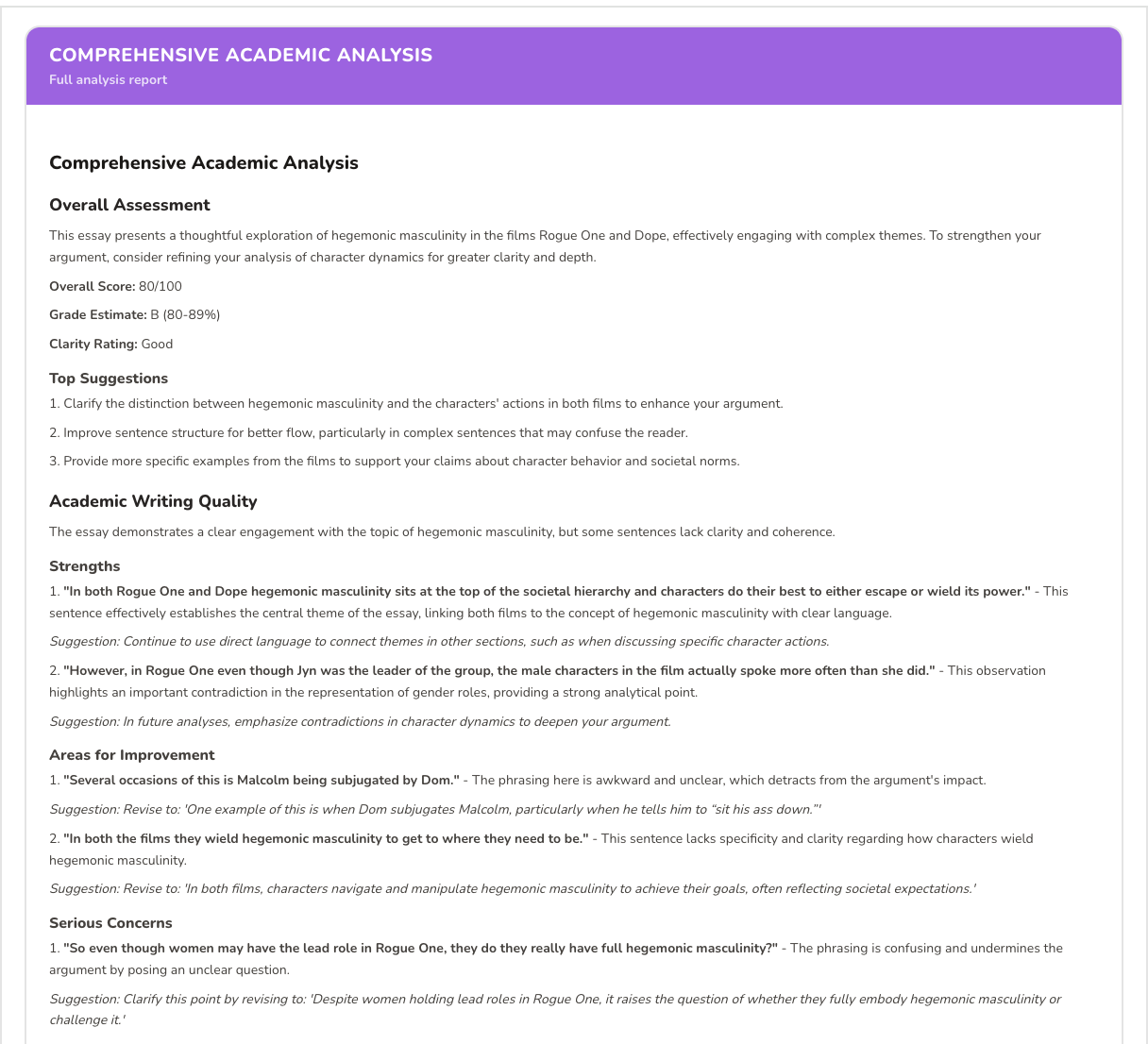
In about 60 seconds you get an estimated grade band and a professor-style rubric, with every category scored: thesis, evidence, structure, clarity and citations.
Apply line-by-line fixes in one click
Feedback is mapped to your exact sentences. Accept a suggested rewrite and it drops straight into your draft, exactly where it belongs.
Export a perfectly formatted Word doc
Word in, Word out. Export and your formatting, headings and references come back intact, ready to submit.
A real rubric, not generic praise
Every essay is scored against a professor-style rubric so you know exactly where the marks are won and lost, instead of a vague “looks good, a few suggestions”.
- Thesis & argumentIs your central claim clear, arguable and carried through the whole essay?
- Evidence & analysisAre claims backed by evidence, with your own reasoning, not just quotes?
- Structure & flowDoes each paragraph lead with its point and connect to the next?
- Clarity & styleHedging, wordiness and weak verbs flagged sentence by sentence.
- Citations & sourcesAPA, MLA, Chicago or Harvard, checked for consistency and formatting.
What your essay grade means
Every essay gets a letter grade and a score out of 100 (or a UK class and percentage). Here is what usually separates one band from the next.
A essay (90 to 100)
A clear, arguable thesis carried through every paragraph. Evidence is analysed, not just quoted, and the conclusion says why the argument matters.
B essay (80 to 89)
A solid argument with one real gap: a paragraph that summarises instead of arguing, evidence that is described more than analysed, or a thesis that drifts by the end.
C essay (70 to 79)
The essay describes more than it argues. Topic sentences are missing or vague, quotes do the work, and the conclusion repeats the introduction.
D or F essay (below 70)
No clear claim, little relevant evidence, or the essay answers a different question from the prompt it was set.
Sample feedback from the essay grader
Comments point at your exact sentences and come with a rewrite you can accept or ignore. Three examples from a sample essay:
Thesis
Social media has many positive and negative effects on teenagers.
Feedback: This is a topic, not a claim. Nobody could disagree with it, so there is nothing for the essay to argue.
Social media harms teenagers less through screen time than through feeds built to keep them comparing themselves with others.
Evidence
"Many teens say they feel pressure to look perfect online" (Smith, 2021). This shows social media is bad.
Feedback: The quote does all the work and the analysis is one vague sentence. Say what the evidence shows and how it proves your thesis.
"Many teens say they feel pressure to look perfect online" (Smith, 2021). The pressure comes from the ranking, not the phone: a feed that rewards the most polished posts turns every scroll into a comparison.
Clarity
It could perhaps be argued that the novel seems to suggest that ambition is, in some ways, dangerous.
Feedback: Four hedges in one sentence. Markers read this as you being unsure of your own point.
The novel argues that ambition becomes dangerous once it outruns conscience.
Why not just paste it into ChatGPT?
A general chat box gives you one block of “here are some tips” with no grade, no rubric and no idea whether you are handing in a B or an A. WriteScholar is built to mark essays: a consistent rubric, a grade estimate, feedback tied to your exact sentences, and fixes that drop into the draft, all without copy-pasting back and forth.
Who the essay grader is for
High school
AP Lang and AP Lit essays, IB coursework, English and history assignments. Catch the structure problems before your teacher does.
College and university
Argumentative essays, research papers, literature reviews and lab reports, up to 15,000 words. Paste your professor’s rubric and the feedback follows it.
College applications
Personal statements and Common App essays are read differently from coursework, so they get their own grader.
College essay graderWriting in a second language
Every comment explains why a sentence is weak, not just that it is, so you learn the pattern instead of fixing one line.
How to raise your essay grade with it
Grade the full draft early
Run it at least two days before the deadline, so there is time to act on the feedback instead of just reading it.
Fix the two lowest rubric scores first
A weak thesis or thin analysis costs far more marks than a dozen commas. Start where the score is lowest.
Add your assignment rubric
If your teacher gave you a rubric, paste it in. You get a criterion-by-criterion check of what is met, partly met and missing.
Re-grade and compare
Run the revised draft again. Seeing a C+ turn into a B+ tells you the changes worked before your teacher ever sees them.
Frequently asked questions
How accurate is the grade?
It is an estimate designed to catch the weak-thesis, no-evidence and waffly-paragraph problems before you submit. It is not a guarantee of the mark your professor will give and it does not replace them, it helps you hand in a stronger draft.
How much does the essay grader cost?
$1 gets you a 7-day trial with 5 credits, and each essay analysis uses 1, so you can grade your own essays with the full rubric, every comment and one-click fixes. After that, Pro is $19.99/mo for 99 credits, and unused credits roll over. Cancel anytime.
What kinds of essays can it grade?
Argumentative, persuasive, analytical, expository and compare-and-contrast essays, research papers, literature reviews, lab reports and personal statements. Pro handles papers up to 15,000 words.
Can it grade my essay against my teacher’s rubric?
Yes. Paste or upload the rubric with your essay and you get a criterion-by-criterion breakdown of what is met, partly met and missing, on top of the standard grade.
Does it use US or UK grades?
Both. Choose US to see a letter grade and a score out of 100, or UK to see a degree classification (First, 2:1, 2:2 or Third) with a percentage.
Can I import and export Microsoft Word documents?
Yes. Import a .docx and your formatting, headings and citations carry over. Export and it comes back as a clean, correctly formatted Word document.
Is using an AI essay grader cheating?
No. WriteScholar grades and gives feedback on work you wrote, the same as asking a tutor to read a draft before you submit. It does not write the essay for you.
Is my essay kept private?
Yes. Your essays stay private to your account and are never used to train AI.
Does it check whether my essay sounds like AI?
No. It is an essay grader, not an AI detector. It scores the writing itself: the argument, the evidence, the structure and the clarity.
What is the difference between the essay grader and the AI essay checker?
They use the same grading. The essay checker is for pasting in a finished draft for a one-off check. The essay grader puts the grade inside a full editor, so you can apply fixes and re-grade as you revise.
Learn the essay first, then grade it
Step-by-step guides for every essay type, with structure, worked examples, and the mistakes that cost the most marks.
Claim, evidence, rebuttal.
Break a text down properly.
Build a case that lands.
Explain without arguing.
Structure a story with a point.
Two subjects, one argument.
From question to conclusion.
Admissions-ready personal writing.
One sentence that carries the essay.
In-text and reference list rules.
Personal statements and Common App essays.
Check your grade before you submit.
Five tools compared honestly.
A straight answer on what to trust.
Turn this essay from a B into an A
Write it here, see the grade and rubric, apply the fixes, and export a clean Word doc, all before the deadline.
Sign in with GoogleSign in to WriteScholar with Google